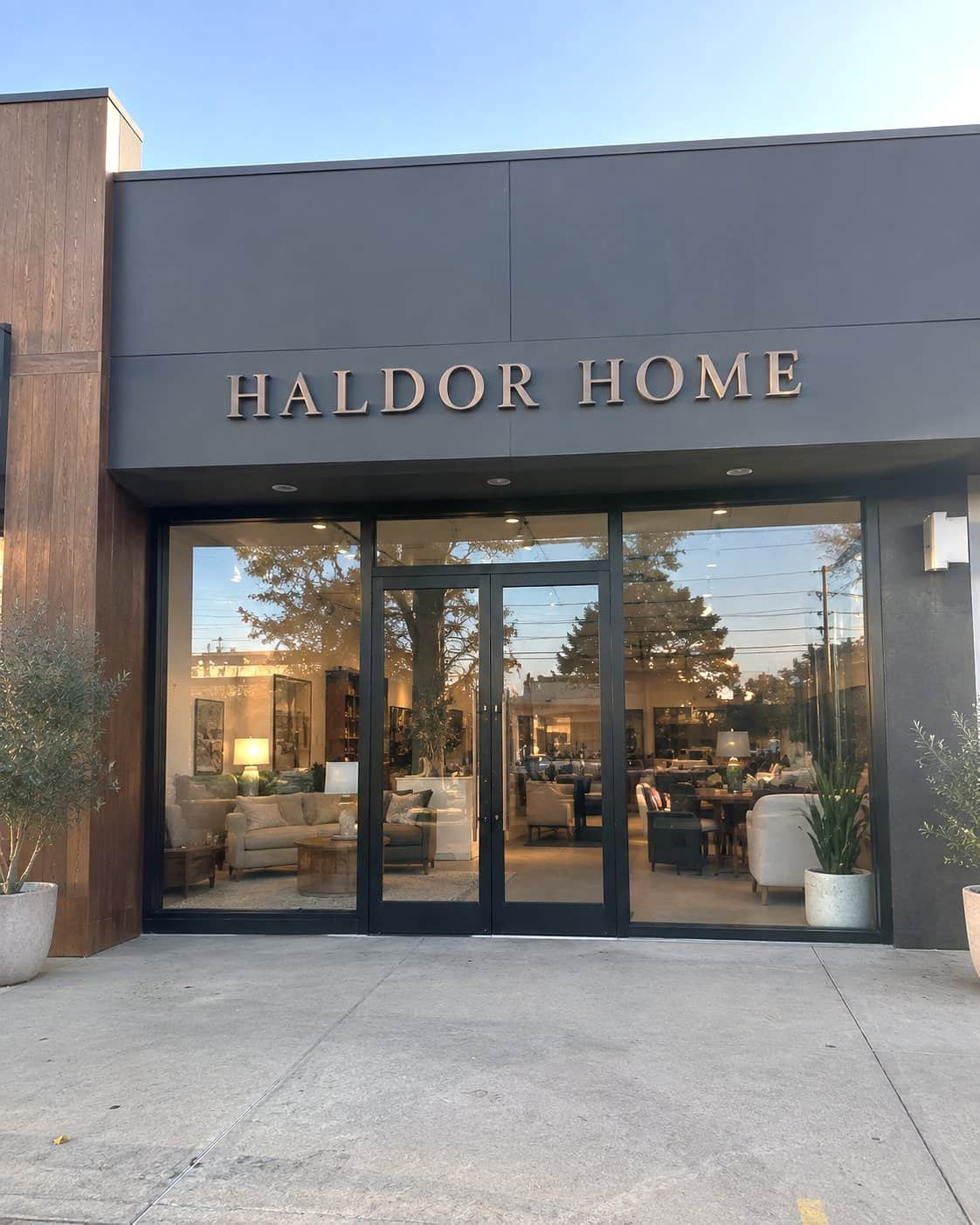
Haldor Home
The furniture was good. The brand around it looked like a discount warehouse. Here is how we repositioned it and what happened to the size of every order.
Why "Haldor Home"? It's a made-up name. We don't publish our clients' real names or exact strategies, because those are their edge in the business.
01 The Challenge
Great furniture.
A brand that undersold it.
Haldor Home carried quality pieces at fair prices, but nothing about the brand said so. The logo, the photography and the website all looked like a clearance sale, so shoppers walked in expecting to haggle and walked out with the cheapest item on the floor.
The owners knew the brand was holding sales back. What they didn't have was one team to fix the name, the look, the website and the showroom message together, so every earlier attempt only fixed a piece.
Furniture is a considered purchase. People buy from brands they trust with their home, and trust is built in the details they notice before they ever speak to a salesperson.
02 The Strategy
How we rebuilt the brand, piece by piece
Started with who they are to the customer
We rewrote the brand positioning around what the store does best, then carried one clear message through the name treatment, the tone of voice and every page, ad and sign.
Made it look like a home worth buying from
New photography direction, a calmer color palette and room-style product pages replaced the sale-flyer look. The goal was a store that feels worth paying full price at.
Built the site around bigger orders
We reorganized collections into rooms and sets, added clear bundle options and made the next step obvious, so shoppers add the sofa and the table instead of just one.
Described at a high level on purpose. The exact setup stays private to the client.
A look at the work
03 The Results
What the relaunch did to the numbers.
A furniture sale doesn't happen with one click. We changed how the brand looked and spoke, so shoppers trusted it enough to spend more.
What we took from Haldor Home
Is this your showroom? Press play
Frequently
asked questions

We help furniture businesses make more money, keep more of it, and build a business that gets easier to run as it grows.
That can mean bringing in more customers, improving advertising, fixing sales and follow-up, increasing Marketplace sales, building better systems, reducing operating costs, or automating work that shouldn't need to be done manually.
We start with what's holding the business back and work from there.
Furniture is where we've built our experience, and it's where we're focused. That's 4+ years, 7+ businesses and $8M+ in marketing dollars, all in the furniture industry.
We've spent years working through the realities of selling furniture: showroom traffic, inventory, financing, Marketplace, advertising, sales teams, customer follow-up, delivery, margins and the systems behind the business.
That experience changes how we approach the work.
That's more common than you might think.
If something is working, there's no reason to throw it away. We'll look at what's already in place, where it's performing, and where the business is still losing money or opportunities.
Sometimes the missing piece is marketing. Sometimes it's what happens after the lead comes in. Sometimes it's the systems behind everything.
No. Advertising is one part of the picture.
We can work across Meta, Google, Marketplace, creative, offers, sales, CRM, follow-up, ecommerce, customer support, automation and operations.
The starting point is always the business problem, not a particular platform.
Yes.
Marketplace can be a significant sales channel for furniture businesses when the listings, inventory, pricing, creative, response and follow-up are handled properly.
We can help build the system around Marketplace instead of treating it as a place to simply post more products.
We look for the biggest constraint on the business.
If you need more demand, we work there. If you're already getting plenty of leads but aren't converting enough of them, that's where we focus. If revenue is growing but costs and owner workload are growing with it, we look at the systems behind the business.
Fix the biggest problem first. Then move to the next one.
Yes. This is one of the areas where the impact can be significant. Across the businesses we've worked with, we've seen average operational cost reductions of more than 50%.
We look at where money and time are being consumed, then improve the underlying process through better systems, automation, AI and distributed teams where appropriate.
The aim isn't to make the business smaller. It's to make it more efficient so it can handle more without the same increase in cost and workload.
We use AI where it makes the business faster, more responsive and more efficient: customer support, reporting, analysis, creative, content, CRM, workflow automation and other repetitive work. The point isn't to use it because it's new. It's to use it where it gives the business an advantage.
AI works best when it takes repetitive work off people's plates rather than simply replacing people. There are plenty of tasks that don't need a person spending hours on them every day. Those are the areas where automation can make a real difference.
Your people can then spend more time on customers, sales, decisions and work that actually needs them.
It depends on what we're working on and how quickly the business can implement changes.
For businesses that are ready to make improvements and can move quickly, it's common to start seeing meaningful changes within the first 30 days, sometimes sooner.
Larger businesses with multiple locations, complex processes, larger teams or longer decision chains can take closer to 90 days to see the full effect of bigger changes.
We don't put an arbitrary revenue number on a business before we've seen how it operates.
What we do commit to is clarity: what we're responsible for, how it will be measured, and looking for improvement from the start, then building on it.
Bigger changes, like rebuilding systems or improving several departments at once, take longer to show their full impact, and we'll tell you that up front.
Every business needs something different, so we don't force everything into the same package.
We'll first understand what you're trying to accomplish, what's holding you back and what needs to be done. From there, we'll scope the work around the business.
You pay for the work that actually needs to happen, not a list of services you don't need.
Most meaningful growth work needs enough time to understand the business, implement changes and see what those changes produce.
For many engagements, that means working together for around three months or longer. Some work can show an impact much sooner, while larger systems naturally take more time to build.
We'll tell you what the work requires before we start.
Yes, both. We've worked with businesses at different stages, from smaller owner-operated stores to multi-location businesses with much larger revenue.
For smaller businesses, the important question isn't how big you are. It's whether there's a real opportunity to improve and an owner who is ready to act on it.
As you grow from one location to several, the problems change. Marketing has to become more consistent, sales need better visibility, and teams need clearer processes. What worked at one location doesn't always work at five. That's where systems become increasingly important.
We talk about the business: where you're at, what's working, what's not, what you're trying to achieve and what you think is getting in the way.
Then we look at the situation together and figure out where the biggest opportunity is. If there's something worth fixing, we'll tell you where we'd start.
Bring us the business as it actually is. We'll take it from there.